

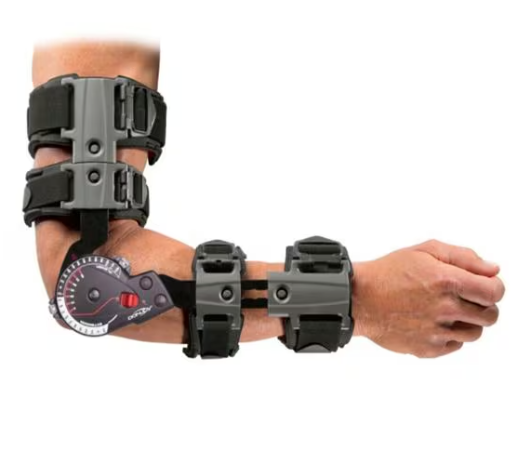
Post-op elbow support with ROM (Range of Motion) is a specialized, hinged brace used to stabilize the elbow joint after surgery or injury while allowing for controlled, gradual movement during rehabilitation. This prevents stiffness and helps restore normal function at a pace determined by a medical professional.
Key Features:
- Hinged Mechanism: The core feature is a dial-based hinge system that can be set to specific flexion (bending) and extension (straightening) angles, often in 10° or 15° increments. This prevents the elbow from moving outside a safe range, protecting the healing tissues.
- Adjustable ROM Control: The range of motion can be easily modified as the patient's recovery progresses, usually via a press-and-rotate locking system.
- Telescoping Design: Many braces feature length-adjustable aluminum bars to ensure a proper and customized fit for different arm sizes (humerus and forearm length).
- Comfort and Stability: They are generally made with lightweight, breathable materials and padded straps to provide comfort during extended wear.
- Versatile Fit: Most designs are "one-size-fits-most" and can be used on either the left or right arm, often with a detachable shoulder sling for added support if needed.
- Indications: They are used for a variety of conditions, including ligament repairs, stable fractures, dislocations, ulnar nerve entrapment, and general post-operative immobilization.
How to Use One:
- Consult your Surgeon: Always obtain clearance and specific instructions from your surgeon or physical therapist before fitting or adjusting the brace. They will set the initial, precise ROM limits based on your surgical outcome and recovery stage.
- Fitting: The brace is typically fitted by aligning the hinge center with the lateral epicondyle (the bony prominence on the outside of the elbow). Straps are then adjusted to be snug but comfortable, ensuring proper stabilization.
- Adjustments: The angle adjustments are usually made by pushing buttons or rotating dials on the hinge mechanism to the desired flexion and extension limits.
- Rehabilitation: As healing progresses, a physical therapist will advise you on how to gradually increase the range of motion of your elbow to regain function and prevent stiffness.